Friday, September 05, 2014

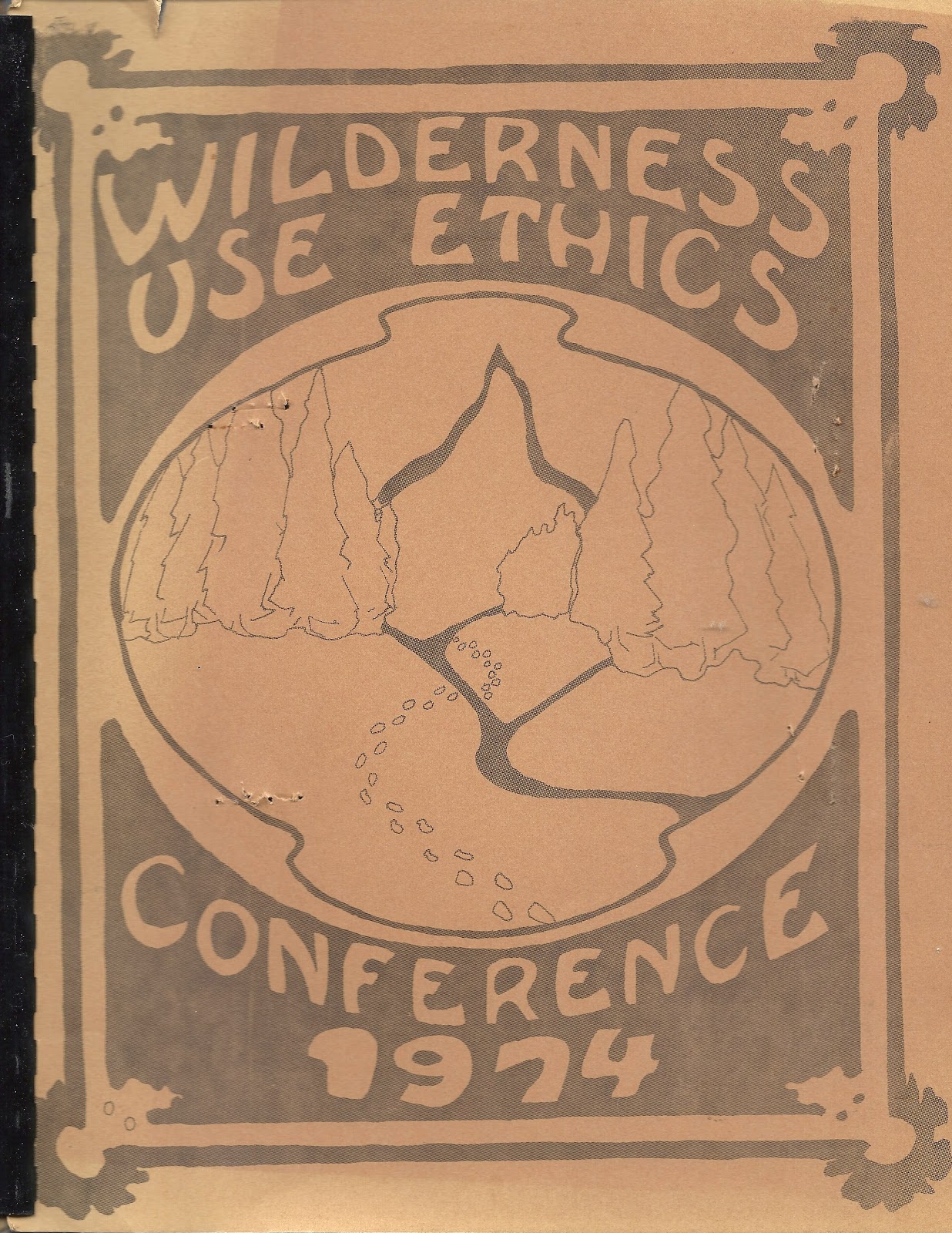
Wilderness Use Ethics Conference Proceedings, 1974 - University of Oregon Outdoor Program

I participated in and have a copy of the proceedings of this conference, but until fairly recently I could not find a reference doing a search on the Internet.  Now there are a few search results you can find for it on Google for "Wilderness Use Ethics Conference"  The 74 page document is apparently available at the University of Oregon.


This unique conference was organized by users of wilderness concerned that the vast majority of wilderness environmental energy had been going towards land classification efforts. The problem of wilderness user impact, overcrowding, human waste disposal, noise pollution and other impacts, even in sparsely used areas was on the rise and needed to be addressed.  The conference was organized by the University of Oregon Outdoor Program.  Bruce V. Mason, Conference Coordinator.
The Wilderness Use Ethics Conference held on April 25-28 at Mckenzie Bridge, Oregon brought together a knowledgeable and diverse group of wilderness users, managers and research personnel to discuss these issues and to encourage a management ethic that allows increased public input into wilderness and wild river management plans.
Conference participants developed nine unique model environmental wilderness projects in Idaho, Oregon and Washington that were implemented after the conference. One of these was the Lower Salmon River Cleanup in Idaho that involved over 100 people, took 3 years and received the 1976 National Environmental Award, the highest public service award that can be presented by the U.S. Department of Interior.

Project reports included in the proceedings included the following:
  1. Willamette River Cleanup  - Mel Jackson, City of Eugene, Oregon
  2. Alpine Lakes Wilderness Cleanup in Washington - Mike Collins, Recreational Equipment, Inc.,  Seattle Washington
  3. Three Public Education Projects in Washington - John Miles, Western Washington State
  4. Human Waste Disposal Survey - Mike Saul, Sundance Expeditions, Grants Pass, Oregon
  5. An Environmental Practices Book - Robert R. Bostick, Oregon State University
  6. Public Wild River Environmental Project - Gary O. Grimm, University of Oregon
  7. Owyhee River Study Project - Kathleen Howes, University of Oregon
  8. Middle Fork Salmon River Environmental Project - Gary O. Grimm, University of Oregon
  9. Salmon River Cleanup - Art Pope, University of Oregon


Wednesday, September 03, 2014

French Pete Wilderness Protest November 18, 1969

After the Wilderness Act was passed in 1964 many people were visiting these unique areas and also surrounding areas that had not been included in the act.  French Pete was one valley that was not included in the Three Sisters Wilderness area and was found to be scheduled for clear cut logging in the near future.

With friends in Eugene I hiked and skied in this area in the late 1960s and, was involved with in what may have been the first public demonstration against national forest policy ever held. In Eugene, an estimated crowd of 1500, composed of students and faculty at the University of Oregon, community citizens and members of environmental groups marched to the headquarters of the Willamette National Forest. An Outdoor Program Common Adventure project called "Nature's Conspiracy" organized the rally.

Author Ken Kesey spoke briefly in support and entertainer Mason Williams gave a free concert later.

After the rally logging was temporarily delayed in the French Creek Valley while appeals were considered.

A Save French Pete Committee and other groups including the Friends of the Three Sisters Wilderness, the Oregon Conservation Council, the Eugene Natural History Society, and outdoor groups like the Obsidians and the Chemeketans kept fighting for Wilderness designation.

At the U.of O Outdoor program we also organized a public "Environmental Meetings" in 1971 and later to continue the dialogue about French Pete and similar Wilderness issues

 Nine Years later French Pete was added to the Three Sisters Wilderness system.

Do a Google Search for "Save French Pete Rally" to find news and historical articles.


Kevin R. Marsh in his book "Drawing lines in the forest: creating wilderness areas in the Pacific Northwest" provided this insight.

"The growing counterculture movement at the time lent support and participants to this this new era of wilderness protests.  Historian Roderick Nash noted in 1973,  'The environmental renaissance of the late1960s and early 1970s paralleled a deep-rooted questioning of established American values and institutions on the part of what some labeled the 'counterculture.' Wilderness and the idea of Wilderness played a key role in both social-intellectual movements.'  Protests in Eugene to preserve French Pete from logging gave that community a national reputation for environmental activism.  Bob Wazeka compared Eugene's role in the wilderness movement of the 1970s to the role of Paris as the center of the Western Literary World of the 1920s."

I also plan to post similar information about personal experiences I have had with the  1964 Wilderness Act issues as time permits.  The following are potential examples. 


  • Common Adventure Outdoor Program - University of Oregon 1967
  • Denali Clean Climbing and Cleanup 1970s
  • Wilderness Environmental Pursuits 1972
  • Cooperative Wilderness Adventures 1973-79
  • Wilderness Use Ethics Conference - 1974
  • Salmon River Cleanup - 1970s
  • Wilderness and Individual Freedom Conference 1976
  • Selway Bitteroot and River of No Return Wilderness Traverse 1979
  • Moonshadow - Total Eclipse of the Sun 1979
  • Canoe Expedition entire length of Salmon River in Idaho 1980
  • Owyhee Canyonlands video 1993
  • Visions of Wilderness video 1993
  • 360 degree interactive panoramas of Idaho Wilderness areas 2003- 2014
  • Google Earth and Map projects 2006-2016

Thursday, August 21, 2014

New Google Earth Imagery for SW Idaho

This Google Earth Blog today provided a kml file for fresh new Google Earth Imagery.

I noticed that a big section of SW Idaho including the Snake River starting at Grandview to Weiser, the Boise River to Lucky Peak Dam, the Payette River to Horseshoe Bend, and a small part of the Weiser River is included.


Monday, August 18, 2014

Lucky Peak Reservoir, Idaho Gigapan

I shot another Gigapan (190 telephoto images) looking over Lucky Peak Reservoir on the same day as Arrowrock Dam. (April 20, 2013)
http://www.gigapan.com/gigapans/161001
The small image below can be viewed full screen. The Gigapan page link above provides thumbnail snapshot views that will zoom in to some interesting features. Use the full screen option in both views to see the highest definition and quality. You can also view these Gigapans in Google Earth and on Google Maps.


Arrowrock Dam Boise River Idaho Gigapan

I uploaded this 260 telephoto stitched image of the Arrowrock Dam to my Gigapan site. You can zoom in on the photo to see fine details. Use the "full screen" option to see the highest quality.http://www.gigapan.com/gigapans/160997


There is study plan to raise the level of the dam 70 more feet to store more water above Boise. Do you agree that this needs to be done? Below is a link to an Idaho Rivers United opinion.

Saturday, August 16, 2014

Barry Lopez - French Pete Rally Protest in Eugene, Oregon on November 18, 1969

Read Barry Lopez article  in Outside Online titled "The Case for Going Uncivilized."  

I lived in the Eugene Area and knew Barry Lopez during the late 1960s and  1970s.  I was also involved with many other community members and students in the French Pete Rally Protest in Eugene, Oregon on November 18, 1969.


Barry describes this protest in the article and explains that "The Wilderness Act had stripped the Forest Service of the power it once had to designate wilderness areas, turning it over instead to Congress, where citizens had the right to actively participate in the process."

"The industry, of course, never got the timber in French Pete, but the fight against corporate greed, ethical compromise, special-interest land management, and excessive development hasn’t ended. We enlighten each other; we heal our wounds; and the young take to the walls yet again—with great courage, great effort, great faith. Then, for a few more years, we feel blessed."

I found this additional  interesting quote in a book titled "Drawing lines in the forest: creating wilderness areas in the Pacific Northwest" by Kevin R. Marsh about the French Pete protest.  "Protests in Eugene to preserve French Pete from logging gave that community a national reputation for environmental activism. Bob Wazeka compared Eugene's role in the wilderness movement of the 1970s to the role of Paris as the center of the Western literary world of the 1920s."
http://www.amazon.com/Drawing-Lines-Forest-Weyerhaeuser-Environmental/dp/0295990112

Friday, August 15, 2014

"Mother of All" Human Caused Atmospheric Water Vapor Feedback Amplifying Mechanism.

"Stick a Fork in it!" (See Dr. Andrew Dessler quote below.)

Is it way too late to control a "human caused water vapor feedback amplifying mechanism" that results in a wetter atmosphere and increasingly unprecedented storms on earth?


Future and general universal and temporal knowledge about overall climate change and global warming on Earth may be generally unpredictable given our current state of scientific knowledge, however many rigorous studies provide very strong evidence that human causes are at least partly responsible and therefore could be mitigated somewhat if public pressure and political will were aligned to this end.  We have had decades of forewarning about this problem and the human caused results are increasing without significant solutions being formulated by our political leaders.

This recent article hosted by the Guardian by John Abraham and Dana Nuccitelli titled "Global warming is moistening the atmosphere" provides details about a long term study that provides scientific evidence that "Human-caused global warming is causing the upper troposphere to become wetter."

One quote at the bottom of the article is attributed to Dr. Andrew Dessler;

Because of water vapor’s importance as a greenhouse gas, the water vapor feedback occupies a central role in the climate system. Over the years, our understanding of this process has increased steadily, and this paper is a very useful contribution. It nicely demonstrates that the observations of upper tropospheric moistening are unlikely to have arisen without the increase in carbon dioxide from human activities. At this point, I think it would be fair to say, “stick a fork in it, the water vapor feedback’s done.”

Another review of this article and interesting comments are available via this Daily Kos  post by Lefty Coaster titled. " Global Warming is increasing moisture in Earth's atmosphere driving Mother of all Feedback Loops"